
Worked case: original plaster, a 55-inch TV and a Barber City tract house — what happens and what it costs
TV Mounting Mark Westminster follows a typical Barber City job in a one-story house whose family-room wall has never been replaced: a 55-inch TV on a fixed bracket, the studs found through test holes rather than trusted to a finder, and the cords carried in a painted channel instead of inside the plaster.
Bookings aren't open yet. Leave your name and number; your message is recorded, and you'll get one message when a local installer is available.
Worked example. The pictures are AI concept illustrations, not photographs; no installation was performed or arranged through this site; prices are typical Westminster area market ranges, not quotes.
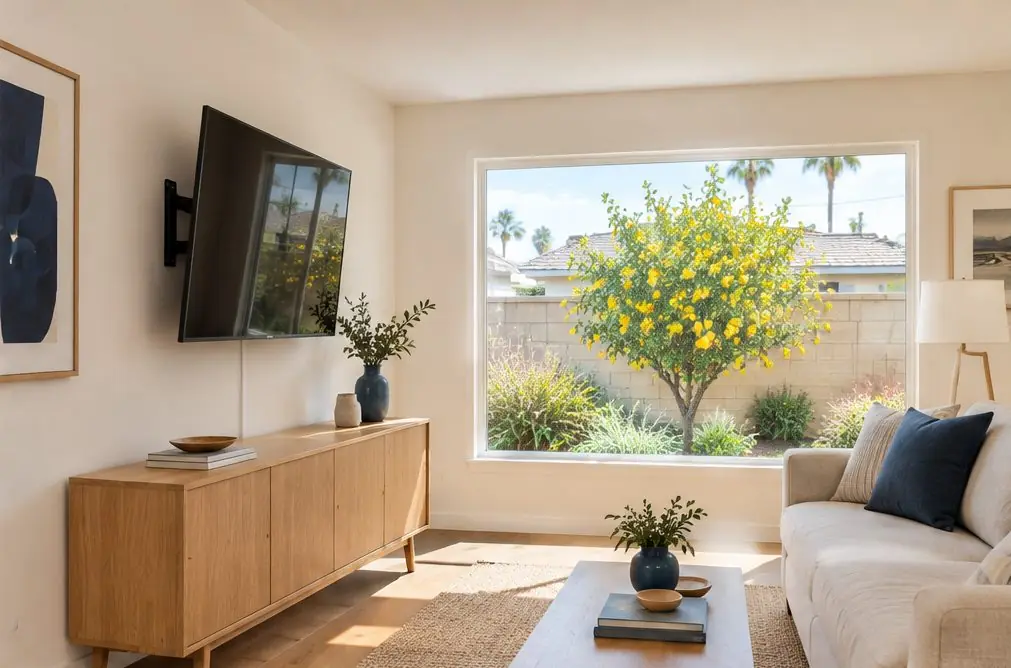 Illustration
Project Examples & Typical Prices
The scenario
Imagine a Barber City house of the kind built on old farm parcels: one story, a family room that opens toward the kitchen, and a back wall that has kept its first coat of plaster over wood lath. The kitchen side was redone in drywall during an earlier update, so two surfaces meet in one room and only a drill can tell them apart. There is a single outlet, low on the plaster wall.
The family watches from a sofa against the opposite wall and, now and then, from the stools at the kitchen counter. They want a 55-inch screen that suits the sofa first and still reads from the counter. With an ordinary ceiling there is no reason to go high; the screen's height is worked out from the sofa, not from any rule printed on a box.
What worries them is the plaster. It is sound, but it has a couple of filled hairline cracks, and they have heard that old walls crumble when drilled.
What the job involves
- The first visit to the wall is with fingertips and a knuckle: the installer finds the old crack repairs and keeps the planned plate clear of them.
- A rectangle of painter's tape shows the screen. It is checked from the sofa and from a counter stool, and nudged until the sofa view is right without losing the counter.
- A thin bit, without hammer action, goes in at the edges of the expected studs. Two holes per stud mark where the wood starts and stops; the center is penciled between them.
- Tape squares go over each bolt position, and a carbide bit turns slowly through plaster and lath so the edges stay crisp.
- Lag bolts long enough to cross plaster and lath sink into both studs. A laser line confirms level before the final turns.
- The set goes onto the plate, the locking screws go in, and a painted channel runs from behind the TV down to the low outlet.
Hardware and materials
- Low-profile fixed bracket sized for a 55-inch set
- Lag bolts with washers, sized for plaster, lath and stud together
- Variable-speed drill, carbide bit, thin test-hole bit
- Painter's tape, laser level, electronic stud finder
- Surface cable channel that takes wall paint
What it typically costs in the Westminster area
| 50–65 inch TV, standard wall mount (labor) | $112–$162 |
| Plaster over lath or early drywall (original 1950s–60s rooms) | +$24–$44 |
| Typical total | $136–$206 (market range, not a quote) |
These are typical local ranges, not a quote or an offer; an installer prices the actual job after seeing the wall.
Add-ons often paired with this job
- Full-motion (articulating) mount — +$28–$48. If the counter seats matter as much as the sofa, an arm can swing the set toward them, at the cost of more leverage on the studs.
- Mount a soundbar as well — +$48–$78. A bar below the screen hangs from its own bracket, lagged into the same pair of studs.
- Take down an existing TV first — +$38–$76. When an older set is already on the wall, lifting it off and filling its holes is a separate line.
Why it is done this way
Old plaster is damaged by speed, not by the TV. Slow drilling, tape over each hole and a few minutes spent on test holes cost little, while a cracked panel around a bolt is a real repair.
The channel replaces an in-wall run on purpose. Cutting a lath-and-plaster wall for cables leaves a patch that tends to show through paint, and the outlet already sits close to the screen.
The kitchen-side drywall is a reminder that one room can hold two kinds of wall. A single test hole tells which one is under the paint, and with it the bit, the speed and the length of the bolt.
The plaster line in the range is what pays for the slower method. A new outlet behind the screen would be an electrician's job and is not part of this scenario.
What would change the price
- Neither stud falls under the planned center, so a wider plate or a painted backer board bridges them.
- The plaster turns out to sit on masonry rather than lath, which calls for masonry anchors.
- An old repair sits exactly where the plate would go, and the plate moves to sound wall.
- A 65-inch set stays in the same size band and uses the same kind of bracket.
- Hiding the cords inside the wall would need a rated in-wall kit, priced as its own line.
Where this leads
- Service page: Tract House TV Mounting — For the one-story houses built over Westminster's old farmland, where each original wall is tested before a bolt is picked.
- Local page: TV mounting in Barber City
- All services and typical prices: TV mounting in Westminster
- More worked examples: Project Examples & Typical Prices
Availability & price range
Check availability and the price range for this setup
Bookings aren't open yet — answer a few quick questions about the TV and the wall and get a typical Westminster price range right here. Typical Westminster prices for one TV, labor only unless an option says otherwise. This is a market estimate, not a quote.