
In-Wall Wire Concealment in Westminster
TV Mounting Mark Westminster covers getting the cables out of sight below a wall-mounted TV in Westminster homes — through the wall with a kit and leads made for that purpose where the wall can be opened, along a painted channel where it should stay shut, and with an electrician called in whenever a new outlet is needed.
Bookings aren't open yet. Leave your name and number; your message is recorded, and you'll get one message when a local installer is available.
 Illustration
In-Wall Wire Concealment in Westminster, CA typically runs $180–$544 per TV in our 2027 estimator, depending on the TV size and the wall type. Use the estimator below for your own numbers.
Which parts are allowed behind drywall
The space inside a wall is not a place for ordinary household cords. A TV's power cord and an extension lead are made to lie in open air; closed inside a cavity they can overheat, get pinched by a screw, and break the code's rules for wiring. What does go in is narrow: a power relocation kit built and listed for in-wall use, which carries power from an existing outlet up to the screen, or a new receptacle that an electrician installs.
Blocking, bays and old plaster
Inside many walls a horizontal piece of framing, the fire block, crosses the bay part way up and stops a cable from dropping straight down. Getting past it means a second opening and more patching, so the route is checked through a small hole first. In the original plaster of an older Westminster house, any cut leaves a repair that rarely disappears under paint, which is why a channel on the surface is often the better choice there.
One kit, one existing outlet
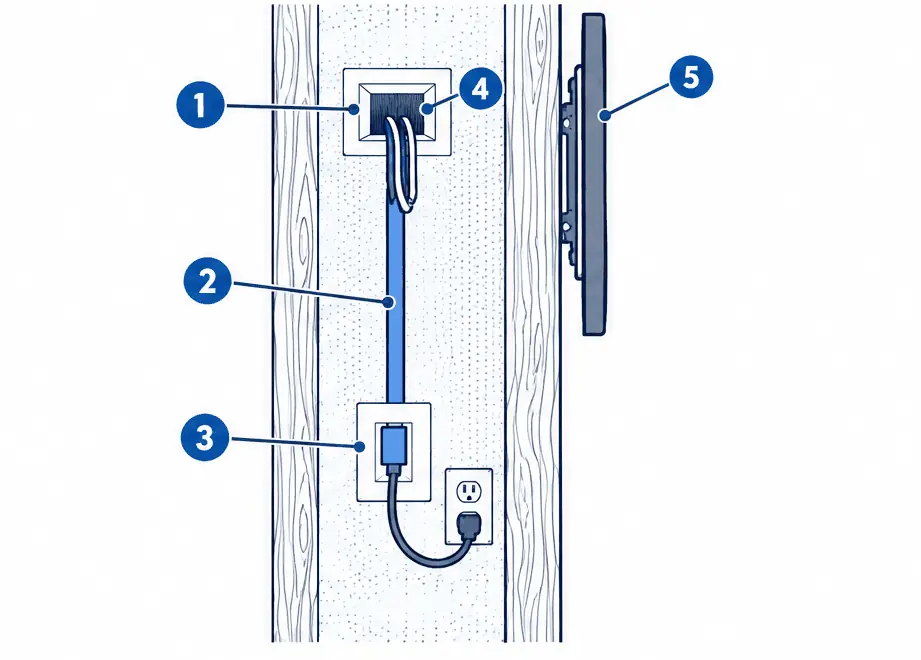
The kit has two plates. The lower one sits beside the outlet already on the wall and plugs into it with a short cord; the upper one, hidden behind the screen, gives the TV a socket to plug into. In between runs a cable rated for the wall cavity. It relocates where the TV plugs in; it does not add a circuit. If no outlet is close enough to use, a new one is an electrician's job and priced on its own.
What the numbers show
- Upper outlet plate A recessed plate behind the screen gives the TV a socket within reach of its cord.
- Rated cable The only power cable inside the cavity, rated for in-wall use.
- Lower inlet plate Connects by a short cord to the existing outlet; no circuit is added.
- Cable pass-through HDMI and other signal leads, CL3-rated, enter through a brush-covered opening.
- TV in front Once hung, the screen covers the upper plate.
When the wall stays closed
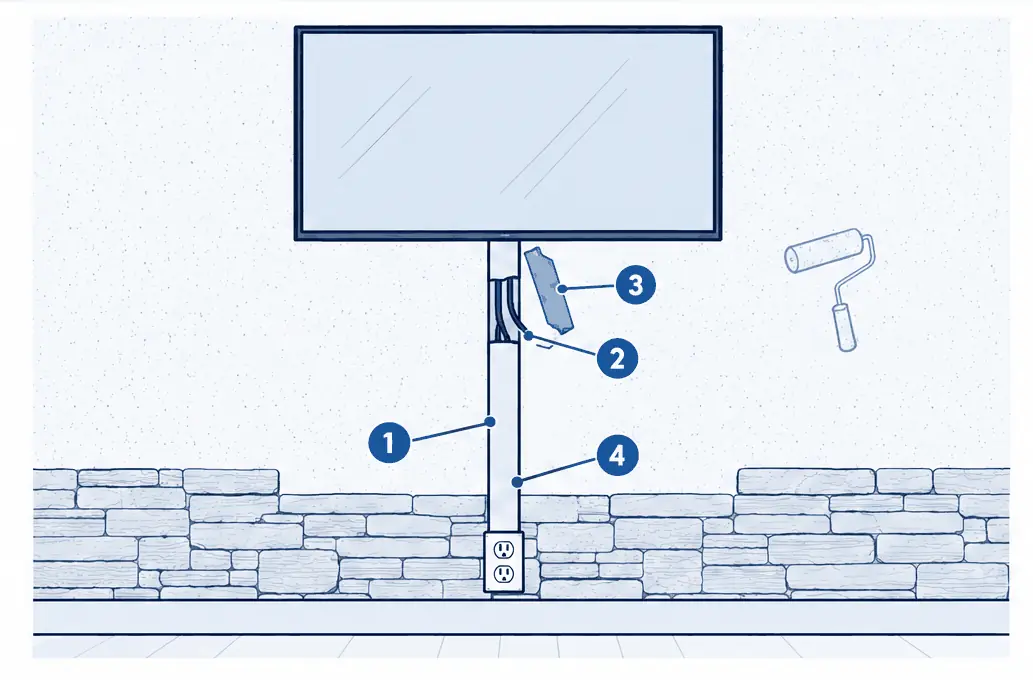
Renters, townhome owners next to a dividing wall and anyone keeping an original plaster wall intact usually end up with a surface channel instead. It is a thin plastic track fixed to the face of the wall, painted to blend in, and it can be taken down at move-out with only small holes to fill.
What the numbers show
- Raceway channel The base of the track is fixed to the face of the wall and holds the cords.
- Cables inside Power and signal leads finish at the outlet already there; nothing new is wired.
- Paintable cover Clips over the base and accepts wall paint.
- Straight run One straight drop from the TV to the outlet reads neatly and can be removed later.
In-Wall Wire Concealment — common questions
Can the TV's own power cord be pushed through the wall?
No. Ordinary cords stay outside the wall; only a kit made and listed for in-wall use carries power inside it.
Does hiding the cables include a new outlet?
No. A new outlet or circuit is electrical work for an electrician and is priced separately from the mount and the kit.
Availability & price range
In-Wall Wire Concealment: check availability and price range
Bookings aren't open yet — answer a few quick questions about the TV and the wall and get a typical Westminster price range right here. Typical Westminster prices for one TV, labor only unless an option says otherwise. This is a market estimate, not a quote.