
TV Wall Mounting in Westminster
TV Mounting Mark Westminster covers the everyday kind of TV wall mounting in Westminster — the front room of a single-story 1950s or 1960s house, the upstairs bedroom of a townhome, the main room of a rented apartment — with the bracket bolted into framing, the height taken from the seats and the cords finished so they do not hang loose.

Bookings aren't open yet. Leave your name and number; your message is recorded, and you'll get one message when a local installer is available.
 Illustration
TV Wall Mounting in Westminster, CA typically runs $92–$396 per TV in our 2027 estimator, depending on the TV size and the wall type. Use the estimator below for your own numbers.
Five checks before the first hole
Nothing gets drilled until five things are known. Skip one, and the TV ends up crooked, too high or held by drywall alone.
- The TV's numbers. Weight, width and the VESA pattern come off the label or the manual. The bracket's rating should be one and a half times the weight or more.
- The wall's material. Drywall, plaster, brick and block each want their own bit and fastener, and in an older Westminster house the answer can change from one wall to the next.
- The framing. An electronic finder marks likely edges; a pin-thin test hole inside the area the plate will cover confirms the wood.
- The seat. Height is taken from the eyes of whoever sits in the main seat, not from the middle of the wall.
- The outlet. Where the power already is decides how the cords can be finished.
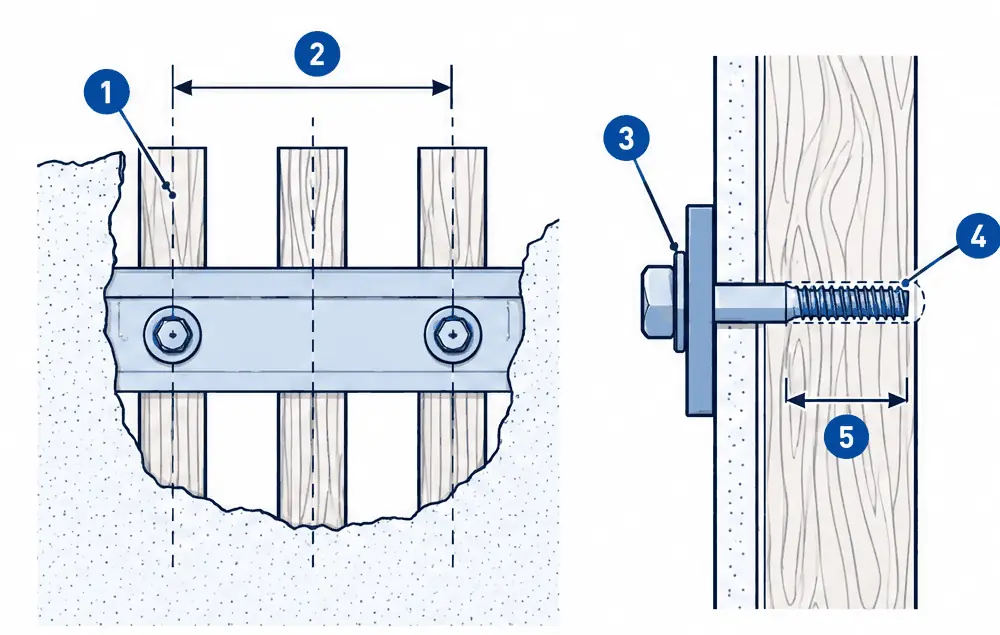
What the numbers show
- Stud center Aiming at the middle leaves the most wood on both sides of the bolt.
- Stud spacing Measured across two bays, first stud to third; at the usual 16 inches on center, a wide plate on the outer pair gets fixings roughly 32 inches apart.
- Washer and bolt head The washer shares the clamping force across the face of the plate.
- Threaded shank The threads cut their own path into the wood and finish inside the stud.
- Embedment depth Enough of the bolt sits in wood to carry the load; a bolt that only reaches the wall face holds nothing.
Flat to the wall or angled: how the room decides
| Situation in the room | Better fit | Reason |
|---|---|---|
| Screen center can sit at seated eye level | Fixed | Stays an inch or two off the wall and never moves |
| Screen has to go above a dresser or a tall media unit | Tilting | A few degrees down bring the picture back to the seats |
| A window or a patio slider faces the screen | Tilting | Changing the angle moves the reflection off the viewer's line |
| One screen has to face two areas | Full-motion arm | Costs more and asks more of the studs; see the full-motion page |
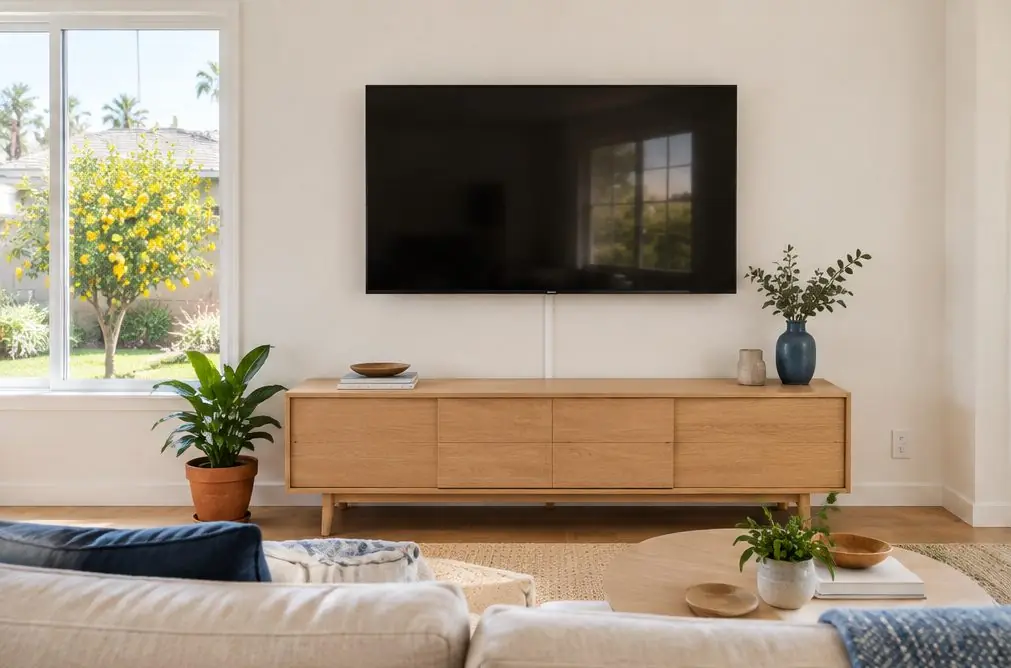
Living rooms in Westminster's single-story houses usually have an ordinary ceiling and the sofa on the opposite wall, which suits a fixed mount. Bedrooms are different: the set tends to go above a dresser and people watch half-reclined, so a tilting bracket earns its small extra depth there.
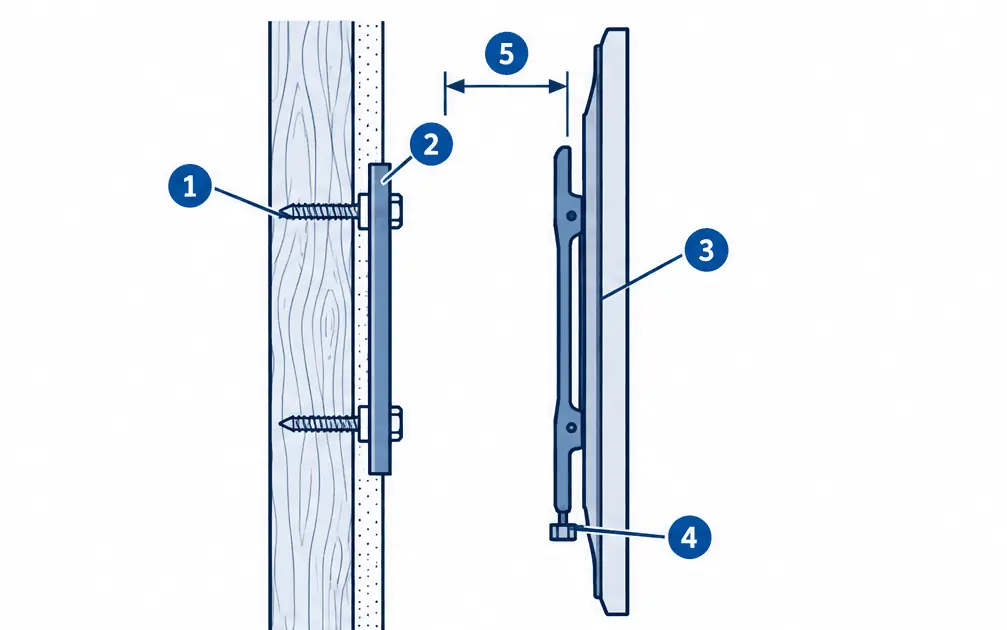
What the numbers show
- Lag bolt in the stud Driven through plate and wall face, the bolt finishes inside the wood, and the wood takes the TV's weight.
- Rails on the plate Upper and lower rails receive the TV's brackets; the level is checked before the final bolt is snugged down.
- Brackets on the TV These screw to the back of the set and drop over the rails; the mount's rating should be one and a half times the TV's weight or more.
- Locking screw Tightened at the bottom of a bracket, it stops an accidental knock from lifting the set off.
- Gap to the wall The space behind the screen leaves room for plugs; once hung, a fixed mount has no adjustment.
When the wood is not where the picture wants to be
Studs are usually framed about 16 inches on center, yet the spot that looks right from the sofa rarely lands on two of them. There are three honest answers, in this order:
- Slide the plate, keep the picture. Most wall plates are wider than the brackets on the TV, so the plate can catch two studs while the screen stays centered on the room.
- Add a backer. A painted board fixed across three or more studs gives the bracket a solid face anywhere along its length.
- Rated toggles for light sets only. Heavy-duty strap toggles behind drywall can carry a small TV on a fixed bracket within their rating. Under a big screen or any arm, they are no substitute for wood.
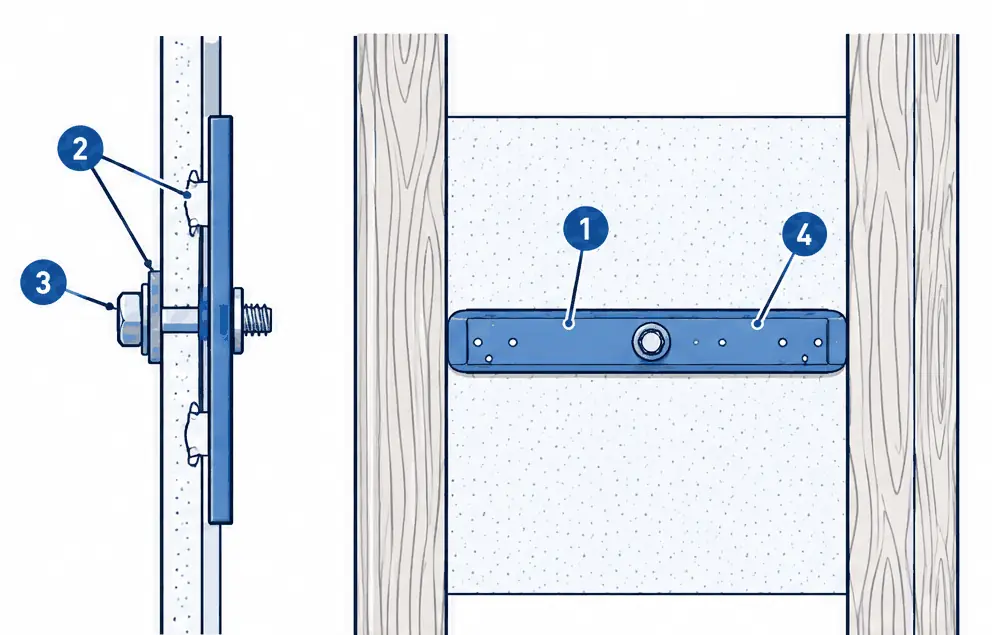
What the numbers show
- Steel channel Lies flat against the back of the board and is longer than the hole, so it cannot slip back out.
- Plastic straps They position the channel while the bolt is started, then break off level with the wall.
- Machine bolt Turned in from the room side, it draws the channel tight and clamps the plate.
- Load spread The load is shared over the back of the board, which is far weaker than wood.
Finishing the cords
| Finish | What it looks like | Notes |
|---|---|---|
| Short bundle | Cords tied tight behind the set, dropping to a low outlet | The simplest finish, nothing added to the wall |
| Surface raceway | A slim channel painted to the wall, from the TV down to the outlet | No wall is opened, and it comes off cleanly later |
| In-wall kit | Cords vanish behind the wall between two rated plates | A separate option on this site, $88–$148 |
An ordinary power cord never goes inside a wall; the in-wall route uses a kit built and rated for it. A brand-new outlet behind the screen is work for an electrician, not part of a mounting visit.
What Westminster rooms usually ask for
In a single-story house the TV tends to land on the one long solid wall facing the sofa, away from the front window and the slider to the yard. Townhome living rooms run narrow, so the screen usually takes the long interior wall rather than the end wall shared with the next unit. Apartments often have one obvious TV wall, and the lease decides whether it may be drilled at all. In each case the visit runs through the same five checks; only the answers change.
TV Wall Mounting — common questions
How much does it cost to put a TV on a drywall wall in Westminster?
In 2027 the labor range is about $92–$132 for a 32–49 inch set and $112–$162 for 50–65 inches, on drywall over wood studs with a bracket the household already has. Bigger screens and harder walls raise it, and the estimator shows each line.
Can a bracket bought online be used?
Yes, when its weight rating clears the TV comfortably and its hole pattern matches the back of the set. It is checked against both before anything is drilled; if it falls short, a supplied mount is the alternative.
Availability & price range
TV Wall Mounting: check availability and price range
Bookings aren't open yet — answer a few quick questions about the TV and the wall and get a typical Westminster price range right here. Typical Westminster prices for one TV, labor only unless an option says otherwise. This is a market estimate, not a quote.